Part 1: The Physical Revolution Inside the Robot Revolution
Everyone is talking about artificial intelligence (AI) in robotics manufacturing. There’s buzz around smarter models, chatter about more autonomous systems, and conversation about faster learning loops.
At its core, robotics manufacturing depends on the ability to produce precision robot components and structural robot parts at scale.
The thing is, in all these conversations, the biggest talk is about the software that’s rewriting what robots can do.
But here’s something that doesn’t make the headlines: all these AI software advancements can’t happen without metal.
From a cobot on a factory floor to a mobile platform sorting packages at 3 a.m. to a humanoid navigating a hospital corridor, behind every robot there’s a network of precision mechanical components doing the job:
- Bearing loads
- Managing heat
- Maintaining tolerances
- Holding it all together through millions of cycles
The AI tells the robot what to do while the aluminum tells it whether it can do it.
Robotics is becoming one of the largest emerging markets for structural aluminum in the world.
This isn’t because of batteries or chips. It’s because of the unglamorous, essential parts that make motion possible.
Robot Components and Structural Design
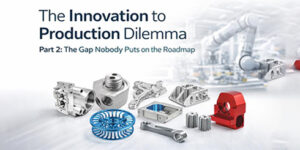
Crack open a humanoid robot and you won’t find anything mystical or magical. What you will find are castings, extrusions, forgings, and precision-machined surfaces.
A single platform can contain 20 to 40 distinct structural aluminum components, each engineered for a specific mechanical function. There may be joint and actuator housings that absorb dynamic loads, keeping everything in alignment.
There are likely motor housings that combine structural support with thermal dissipation. Perhaps there are gearbox and harmonic drive casings that demand tight tolerances and consistent geometry.
Or maybe there are structural frames that define stiffness and weight distribution, and battery and electronics enclosures that protect sensitive systems while managing heat.
No matter what’s on the inside, aluminum is there.
Why? Because its strength-to-weight ratio is exceptional. Plus, it conducts heat efficiently, resists corrosion, and machines cleanly.
When a system needs to be strong, light, precise, and manufacturable at scale, aluminum is tough to beat. These robot components are typically produced using aluminum die casting, aluminum extrusion, and precision CNC machining, depending on geometry and performance requirements.
Not All Aluminum Is Alike (and Neither Are the Manufacturing Processes)
One of the most overlooked facts about robotic manufacturing is that these components aren’t produced through a single method. They require a deliberate combination of processes, each suited to specific performance demands and geometric requirements.
High-pressure die casting handles complex geometries for joint housings, gearbox casings, and motor enclosures. Dimensional consistency and surface detail matter more at high volumes. Extrusions serve linear structural members and frame elements, offering excellent strength-to-weight ratios along a primary axis. Forgings handle the high-load, high-fatigue applications where casting porosity would be a liability (think load-bearing joints and structural nodes).
In most cases, these processes feed into secondary CNC machining, where bearing seats, sealing surfaces, and precision interfaces are brought to final tolerance. For robotics companies, this often means working with partners that provide CNC machining for robotics, aluminum die casting robot parts, and other specialized manufacturing processes.
Getting this sequence right, including determining which process to use for which component, in which order, is where manufacturing expertise becomes a competitive advantage.
The Scaling Challenge Nobody Warns About
This is where robotics manufacturing becomes significantly more complex. At low volumes, this all seems manageable. Parts get machined from billet. Iteration is fast. Engineering teams stay flexible.
But production doesn’t stay low.
When volume targets start climbing into the tens of thousands of units, the entire manufacturing logic must change. Billet machining gives way to casting and forging – processes that are more cost-effective at scale. But this can introduce a new set of constraints that have to be deliberately engineered, including:
- Porosity control in die cast components that face cyclic loading over years of operation.
- Thin-wall geometries that push the limits of structural integrity to reduce weight.
- Tolerance stack-up across cast and machined features in complex multi-axis assemblies.
- Alloy selection based on performance requirements and manufacturability.
- Tooling lead times and capital investment that can stretch longer than development schedules allow.
The Same Inflection Point, Different Industry
The electric vehicle industry offers a useful preview.
In the early years, EV was primarily focused on all things battery-related, such as chemistry, energy density, and charge times. Manufacturing was treated as a downstream problem to solve “later.”
But as production scaled, it quickly became clear that structural manufacturing – castings, battery enclosures, integrated platform architectures – was what enabled volume.
Companies that invested early in manufacturing capability didn’t just produce faster, they produced better, cheaper, and more consistently than competitors who tried to retrofit their design decisions.
Robotics is now approaching this same inflection point. AI is maturing and hardware designs are converging. So it seems reasonable to assume that the companies that will lead the next phase of growth are already thinking about the physical scaling problem now – not later.
Designing Aluminum Components for Manufacturability at Scale
Treating aluminum as a critical system component rather than only a material selection means making decisions earlier and more strategically than most development timelines naturally encourage.
It also means:
- Understanding which processes are appropriate for each component geometry and load case
- Designing for manufacturability before designs are locked
- Building supplier relationships and qualifying manufacturing partners while there’s still time to optimize (not after committing to a launch schedule)
At MES, this is where our expertise lies. We’re not just a sourcing partner. We’re a manufacturing and supply chain advisor supporting robotics manufacturing through aluminum die casting, precision CNC machining, and globally distributed production.
We help connect design intent to manufacturing reality so that when volume ramps, our customers are ready.
AI will continue to define what robots can do. But materials and manufacturing will determine how quickly – and how reliably – they can be built at scale.
If you’re developing robotic systems and starting to think about production scale, the time to align your manufacturing strategy is before your design is locked, not after.
We help robotics companies connect component design, process selection, and supply chain structure into a scalable robotics manufacturing system.