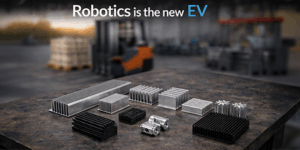
Part 2: The Gap Nobody Puts on the Roadmap
Most robotics companies move quickly in early-stage robotics manufacturing.
Prototypes come together fast. Designs are iterated in real time. Functional units reach customers in months, not years, allowing teams to validate performance, gather data, and refine the system in the field.
During this phase, many robot components and robot parts are produced using flexible methods that prioritize speed over long-term manufacturability. Here, speed is an advantage, and the process works.
At some point (usually sooner than expected), the work shifts from “Does this robot work?” to “Can we build enough of them, reliably, at a cost that makes the business viable?”
A different question demands a different way of thinking.
Scaling Challenges in Robotics Manufacturing and Production
In manufacturing, going from a pilot run of 50 units to a first production batch of 1,000 is often challenging. But going from 1,000 to 50,000? That’s a new level of complexity.
At that scale, the constraints aren’t technical in the traditional sense. The robot works, the software is solid, and the mechanical design is validated.
Yet, suddenly, things that weren’t a problem now become critical. This is especially true in robotics manufacturing when transitioning from billet machining to processes like aluminum die casting and precision CNC machining.
- Parts that performed perfectly when machined from billet don’t translate cleanly to casting, and nobody caught the issue during design.
- Tooling lead times that looked manageable are now stretching three to five months.
- Suppliers that handled the pilot run don’t have the capacity or process discipline to support a production ramp.
- Lead times creep, then expand and soon the supply chain is driving the business instead of enabling it.
None of these problems are unusual. But they tend to show up at the worst possible time: when revenue targets are set, investors are watching, or the pressure to ship is at its highest.
Where Design and Manufacturing Disconnect
Look closely at most scaling failures, and a clear pattern emerges: the product was never fully designed with high-volume manufacturing in mind.
That’s not a criticism, but it is a reality.
In early development, this is the right tradeoff because speed matters more than optimization.
But, carrying the development mindset too far into the production phase can create problems that are expensive and disruptive to fix under pressure, including:
- Robot components that require excessive secondary machining because the casting geometry was never optimized
- Designs that introduce porosity or distortion in high-pressure die casting because the DFM review happened too late
- Tolerance stack-ups across cast and machined features that only reveal themselves in full assemblies at volume
- Tooling that must be reworked or rebuilt mid-ramp, costing both time and capital.
Supply Chain Decisions Have a Shelf Life
There’s another pattern that shows up regularly and it’s equally predictable.
Manufacturing and supply chain decisions tend to be treated as execution work, with things to be sorted out after the product design is stable. It seems logical to finalize the design, then figure out where and how to build it.
The problem is that by the time the design is finalized, most of the important supply chain constraints have already been baked in by the choices that were made along the way:
- Where a part can be produced
- How it flows through machining and assembly
- Whether it can be sourced from multiple regions or is tied to a single specialized supplier
- How easily capacity can expand as volumes grow
When these decisions are deferred, manufacturers often end up concentrated in a single geography with no backup when disruption hits, exposed to tariff shifts or geopolitical instability, and locked into lead times and minimum order quantities that make it difficult to respond to changes in demand.
None of this is intentional. It’s simply the result of treating supply chain as a procurement exercise rather than a strategic one. At this stage, many companies begin searching for a custom robot parts manufacturer after key constraints are already in place.
A Similar Transition in EV Manufacturing
The electric vehicle industry went through a similar transition, on a compressed timeline, with the same patterns playing out across dozens of companies.
Early-stage EV development was driven by software and battery chemistry with manufacturing treated as a secondary concern. As production scaled rapidly, the companies that succeeded weren’t necessarily the ones with the best technology. They were the ones that had pulled manufacturing strategy forward into the design and engineering process early enough to build capability.
They designed for casting and extrusion before those processes were needed and built supplier redundancy before a single disruption forced the issue. They modeled total landed cost before committing to supply chain architectures that were hard to change.
On the other hand, those that waited paid the price for it in delays, cost overruns, and competitive ground lost at a critical moment.
Robotics is entering the same phase. Volumes are climbing, production timelines are compressing, and the window to make good decisions is open right now. But it won’t stay open indefinitely.
Building for Scale: Design, Manufacturing, and Supply Chain Alignment
As a supply chain partner to some of the world’s largest OEMs and product manufacturers, we know the difference between smooth scaling and troublesome expansion doesn’t come down to any single decision. It comes down to a series of small decisions made earlier than most development processes allow.
Here are some practical examples of what that could look like:
- Involving manufacturing partners in component design before drawings are released (not after)
- Running DFM analysis on casting and forging candidates while there’s still time to adjust geometry
- Building supplier relationships in more than one region, even when single-sourcing feels simpler right now
- Modeling total landed cost, including logistics, duties, and inventory carrying costs, rather than optimizing on piece price alone
- Treating supply chain structure as a designed system, with the same rigor applied to mechanical design.
At MES, we do more than just source parts. We help companies build the infrastructure that connects design intent to manufacturing processes like aluminum die casting and precision CNC machining, and into a scalable global supply chain. Our goal is to help our customers build a system that can scale without needing to be rebuilt halfway through the ramp-up.
Innovation gets a robot to work. Manufacturing is what lets it scale.
The companies that move fastest through that transition are the ones that recognize early: production isn’t a phase that comes after design. It’s embedded in it.
If you’re moving from prototype toward production and starting to feel friction – in lead times, supplier capacity, or component yields – we can help. Contact us to learn more.