
Why BESS Depends on More Than Battery Cells
The phrase “battery storage” creates a misleading mental picture by suggesting that the battery is the system.
It’s not.
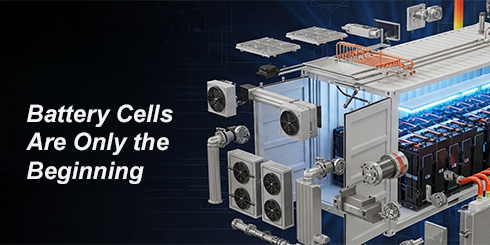
A utility-scale BESS installation looks less like a battery and more like a highly engineered piece of industrial infrastructure. The cells sit at the center, and around them sits everything required to make those cells useful in the real world: the enclosure, the cooling system, the structural framework, the power conversion equipment, the control systems, the safety infrastructure.
The battery stores the energy. Everything else makes the system work.
The Supply Chain Opportunity Behind BESS
The battery-cell market is already crowded with large, established manufacturers.
For many suppliers, the greater opportunity lies in the infrastructure that surrounds the cells.
As BESS deployments scale, the supporting infrastructure becomes increasingly important: enclosure systems, thermal management hardware, cooling manifolds and pipe assemblies, structural frames and rack systems, power conversion enclosures, heat sinks, and control housings.
These aren’t peripheral components. They’re the systems that determine performance, serviceability, reliability, and operating life. And unlike battery-cell manufacturing, much of this supply chain is still being defined.
Follow the Heat
Of all the engineering challenges inside a utility-scale BESS installation, thermal management may be the most consequential.
Every battery cell generates heat during charging and discharging. As energy density increases, heat becomes more difficult to control. The systems that handle it well will operate longer, perform more consistently, and experience fewer reliability issues.
The challenge isn’t simply removing heat. It’s removing heat consistently across thousands of cells through changing weather conditions and over service lives that can span 15 to 20 years.
That’s why cooling manifolds, cooling plates, pipe headers, HVAC housings, and heat sinks rarely make headlines. And yet they help determine how long batteries last, how efficiently they operate, and how reliably a system performs through decades of service.
Thermal management components demand an unusual combination of properties:
- Thermal conductivity
- Dimensional precision
- Durability
- Manufacturability at scale
Components such as cooling plates, manifolds, and heat sinks often require complex geometries that must perform consistently across thousands of operating hours and charging cycles.
In many ways, the future performance of battery storage depends as much on how effectively systems manage heat as on the batteries themselves.
What Manufacturers Should Be Doing Now
Transformer supply chains have evolved over decades. Switchgear supplier relationships often span generations. Many of those markets have deeply entrenched qualification programs and long-established supplier networks.
Battery storage is at a different stage of maturity.
Container architectures continue to evolve. Thermal management requirements are becoming more sophisticated. Domestic-content expectations are increasing. And manufacturers are being asked to scale quickly while maintaining performance, reliability, and cost targets.
For manufacturers and suppliers, this creates an opportunity to solve problems that don’t yet have established answers.
The manufacturers that can support thermal performance, precision manufacturing, supply chain resilience, and scalable production capacity will be increasingly valuable as deployments accelerate.
Why Location Matters
The domestic footprint of the BESS industry is expanding. Major integrators are adding production capacity throughout North America, and proximity, responsiveness, and supply chain resilience are becoming increasingly important considerations.
Fluence Energy provides one example. The company opened a new Ohio manufacturing facility in September 2025, approximately 35 miles from Columbus.
The significance isn’t the building itself. It’s what the building represents: growing demand for the network of manufacturers, suppliers, and component providers that support utility-scale battery storage.
For sourcing teams, that changes the criteria for evaluating suppliers. Manufacturing capability still matters, but so do proximity, responsiveness, engineering support, and the ability to scale alongside growing production requirements.
As battery storage manufacturing expands domestically, the conversation becomes larger than unit cost. Logistics, lead times, engineering collaboration, and manufacturing responsiveness all become part of the equation.
What Sourcing Teams Should Be Asking
For sourcing leaders evaluating BESS opportunities, the most useful exercise right now isn’t a cell comparison. It’s a component map.
A few questions worth asking:
- Which components are controlled by battery manufacturers, and which belong to the broader mechanical, structural, and thermal ecosystem?
- Which component families align with existing manufacturing capabilities?
- Which components can be sourced domestically or through USMCA-qualified nearshore production?
- Where are thermal performance requirements becoming more demanding?
- Which supplier relationships could become strategically important as deployments scale?
- Which sourcing decisions made today could limit flexibility later?
In a market growing at nearly 27% annually, these questions can shape sourcing strategy long before a purchase order is issued.
Looking Beyond the Cells
Battery cells will continue to drive headlines—and they should. The cells are at the center of every battery storage system. But they are only one part of it.
As BESS deployments scale, the infrastructure surrounding those cells will become increasingly important. Thermal management, enclosure systems, structural hardware, power conversion equipment, and the broader supply chain supporting them all play a role in determining how these systems perform over decades of service.
For manufacturers and sourcing teams, that’s an opportunity to look beyond the battery itself and think more broadly about the systems that make battery storage possible.
At MES, that’s where we’re focused. We work with manufacturers and sourcing teams building the physical infrastructure around complex industrial systems—from structural components and enclosure systems to thermal management hardware and precision-machined assemblies.
If you’re evaluating BESS programs and determining which component families are best suited for domestic or nearshore manufacturing, we’d welcome the conversation.