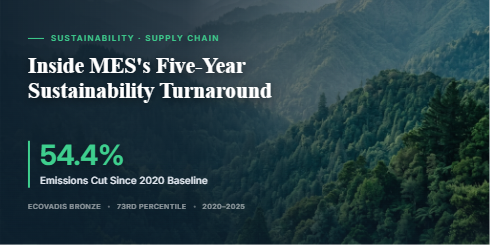
Inside MES’s Five-Year Sustainability Turnaround: A 54.4% Emissions Cut
Cutting emissions sounds simple—until you’re running a global supply chain with volume growing every year. That’s the challenge MES has been tackling head-on for the past five years, and the results are starting to show.
There’s a business benefit to customers, too. More efficient facilities, better shipment planning, stronger supplier alignment, and disciplined carbon management contribute to a supply chain that’s more resilient, transparent, and prepared for evolving sustainability requirements.
As part of our ongoing commitment to reducing greenhouse gas emissions, MES has taken deliberate, measurable action to decarbonize our global operations. One catalyst was our partnership with a global industrial technology leader through its Zero Carbon Project. As one of their top 1,000 suppliers, we saw a chance to help move an entire industry toward net zero, not just our own operations.
Our target? Cut CO2e by 50% by 2030, measured against a 2020 baseline. So far, MES has already achieved a 54.4% reduction in combined Scope 1 and Scope 2 carbon emissions.
EcoVadis Sustainability Rating, May 2026
Numbers are easier to trust when someone else has checked your work. That’s why we’re glad to share that MES earned a Bronze EcoVadis Sustainability Rating, with an overall score of 67 out of 100. This places us in the 73rd percentile globally and within the top 35% of companies assessed.

This rating reflects our continued investment in environmental practices, labor standards, ethics, and sustainable procurement. It’s third-party validation that our carbon reduction work isn’t a one-off sustainability push. Instead, it’s part of a broader, credible program, built for continuous improvement.
The MES Carbon Reduction Project: A Five-Year Journey
Real emissions cuts take more than good intentions. Our approach combines energy efficiency upgrades, operational optimization, and closer alignment with the sustainability goals of our customers, suppliers, and vendors. The result is a ripple effect that reaches well past our own operations and into the broader supply chain we’re part of.
Carbon Reduction Achievements (2020 vs. 2025)
| Emissions Category | 2020 Baseline | 2025 (Location Based) | 2025 (Market Based) |
| Scope 1 | 58 metric tons | 109 metric tons | 109 metric tons |
| Scope 2 | 181 metric tons | 59 metric tons | 0 metric tons |
| Scope 1+2 Combined | 239 metric tons | 168 metric tons | 109 metric tons |
The story behind the reduction breaks down into three parts: what moved, how it moved, and what’s still in motion.
Key Highlights:
- 54.4% reduction in combined Scope 1 and Scope 2 CO2 emissions from our 2020 baseline, driven primarily by eliminating market-based Scope 2 emissions.
- Market-based Scope 2 emissions reduced to zero. Through the purchase of Renewable Energy Certificates (RECs), MES reduced its reported market-based Scope 2 emissions from 181 metric tons to zero.
- Scope 1 is where the next win is. Scope 1 emissions ticked up as operations expanded, marking the clearest opportunity for our next round of efficiency gains.
Sustainability Initiatives: How We Achieved It
None of this happened by accident. MES implemented a range of sustainability initiatives to work across our operations, including:
- Energy surveys and audits to pinpoint conservation opportunities across every facility.
- RECs, purchased to fully address our reported market-based electricity emissions, taking our Scope 2 footprint from 181 metric tons to zero.
- Enterprise-wide carbon management policies to standardize sustainability practices across every operation, company-wide.
- Lighting and HVAC upgrades, moving to energy-efficient LED lighting and optimizing HVAC systems for smarter energy use.
- Package efficiency planning, optimizing container capacity and streamlining forklift operations to reduce the number of shipments needed.
- Waste reduction and recycling programs, expanding how we repurpose materials and put them back into productive use.
- Employee training and engagement, building a culture where sustainability is part of how everyone works every day.
Looking Ahead: Our Path to 2030
We’re proud of the progress we’ve made. We’re also aware that sustainability doesn’t have a finish line. MES has already exceeded its interim milestones toward its 2030 goal of cutting CO2e by 50% from our 2020 baseline, and we’re well on our way.
Meeting future sustainability expectations will require continued innovation, measurement, and operational improvement. Here’s where we’re focused next:
- Piloting automation and data-driven monitoring on the production lines driving the largest share of Scope 1 emissions.
- Evaluating lower-carbon fuel and equipment options as facilities come up for renewal or upgrade.
- Extending carbon accountability further into our supplier and vendor relationships, not just our own four walls.
- Reporting our progress annually, with full transparency, so this milestone is a baseline, not a finish line.
Build a More Efficient, Resilient Supply Chain
Sustainability progress delivers the most value when it improves operational performance. MES combines global manufacturing expertise, supply chain management, and continuous improvement to help customers reduce complexity, improve efficiency, and build more resilient operations.
Our EcoVadis Bronze rating and our carbon reduction progress are milestones we’re proud of. They’re stepping stones, not endpoints.
Looking for a supply chain partner that understands both operational performance and sustainability? Contact MES to discuss your manufacturing and supply chain goals.
About MES
MES is a global supply chain innovator dedicated to sustainability, efficiency, and resilience. With a focus on reducing environmental impact, we provide shorter lead times, cost-effective manufacturing solutions, and forward-thinking supply chain strategies.
Visit mesinc.net to learn more about our commitment to a sustainable future.