Busbar Plating for Data Center Power Distribution: The Choice That Changes How Hot a Joint Can Run
Summary
Busbar plating does more than protect the surface. It affects how hot a joint can run, how stable its contact resistance remains, and how long the finish will continue to perform in service. Tin, silver, nickel, and bare copper each solve a different problem. Tin is cost-effective for static joints but is gradually consumed at temperature. Silver holds low contact resistance well at elevated temperature and is preferred for sliding contacts. Nickel is usually an underlayer that slows diffusion rather than a contact finish on its own. Bare copper can work where joints stay cool, but it comes with a lower allowable temperature. This article compares the tradeoffs behind each option so busbar plating can be specified around the joint’s operating conditions rather than treated as a generic finish.
KEY TAKEAWAYS
ARTICLE
Busbar plating can look like a finishing detail on a drawing. In service, it can change how hot a joint is allowed to run, how stable its resistance stays, and how much copper the design needs to carry the same current.
That matters more as data center power demand climbs. The IEA expects global data center electricity use to more than double, from about 415 TWh in 2024 to around 945 TWh by 2030. Between the service entrance and the rack, that power passes through dozens of bolted busbar joints, many of them carrying high current for long periods.
The 7 Tiers of a Data Center Build-Out looks at why those joints matter mechanically and electrically. Only a small fraction of the apparent overlap in a bolted connection is in true metallic contact, so the condition of that contact surface matters a lot.
Plating helps protect those contact points from oxidation, but it also affects allowable temperature. Under IEEE C37.20.2, an unplated copper bus joint is limited to a 30 °C rise, or 70 °C total, while silver- or tin-surfaced joints are allowed a 65 °C rise, or 105 °C total. ABB’s technical note on bus plating points out that the higher temperature allowance can reduce the amount of copper needed to carry the same rated current.
The choice, then, isn’t simply tin versus silver versus nickel. It’s what the joint has to do, how hot it will run, what environment it will see, and how long the finish needs to last.
That’s where the comparison gets interesting.
Busbar Plating Compared: Tin, Silver, Nickel and Bare Copper
| Property | Tin | Silver | Nickel | Bare Copper |
|---|---|---|---|---|
| Contact Resistance | Low when new; rises as oxide, fretting and intermetallic reach the surface | Lowest, and the most stable as temperature rises | Higher; hard oxide needs more contact force to break through | Low when freshly cleaned; rises as oxide thickens |
| Max Continuous Joint Temperature | 105 °C total (65 °C rise) per IEEE C37.20.2 | 105 °C total (65 °C rise) per IEEE C37.20.2 | Not a standard bus contact finish; stable above 200 °C as an underlayer | 70 °C total (30 °C rise) per IEEE C37.20.2 |
| Intermetallic Growth | Forms Cu6Sn5 and Cu3Sn with copper; grows with the square root of time, faster with heat, and consumes free tin | No intermetallic with copper, but copper diffuses through silver at temperature unless a barrier is present | Forms Ni3Sn4 with tin far more slowly than copper forms Cu6Sn5, which is why it’s used | None; surface oxide grows instead |
| Corrosion Behavior | Good general resistance; preferred where H2S is present; prone to fretting under micro-motion | Tarnishes to silver sulfide in sulfur-bearing air; best in climate-controlled rooms | Good; forms a stable passive oxide | Oxidizes and sulfidizes; relies on cleaning and joint compound at assembly |
| Relative Cost Per Sq Ft (Tin = 1) | 1× | About 4 to 8× at 5 µm; silver metal alone is roughly $9.60/sq ft at $61/oz | About 1.5 to 2× | No plating cost, but more copper per ampere |
| Typical Thickness | 3 to 8 µm static joints (ASTM B545); 8 to 20 µm where long life at temperature is required | 1.3 to 3 µm static joints; 10 to 20 µm sliding contacts (ASTM B700) | 1.3 to 2.5 µm as an underlayer (ASTM B689) | Not applicable |
| Best Fit | Static bolted joints, battery interconnect, sulfur-bearing air | Plug-in stabs, sliding contacts, hot joints | Diffusion barrier under tin or silver; adhesion layer on aluminum bus | Cool-running joints and ground bus |
Tin: Good Protection with a Service Life
Tin works well on static copper bus joints because it combines low initial contact resistance with a relatively soft oxide that bolt pressure can break through. It also performs better than silver in sulfur-bearing environments, which is why ABB recommends tin where hydrogen sulfide is present.
Its limitation is metallurgical.
Tin and copper react at the interface to form Cu6Sn5 and Cu3Sn intermetallic layers. That reaction starts at room temperature and accelerates with heat. Because the growth is diffusion-controlled, the intermetallic layer thickens with the square root of time.
As it grows, it consumes the free tin at the surface. Once that protective tin is depleted, the intermetallic can reach the contact interface, oxidize, harden, and increase resistance.
So tin thickness isn’t just a finish specification. On a hot joint, it becomes part of the service-life calculation. A deposit that is adequate for a cooler static connection may be consumed much sooner on a joint operating near its 105 °C limit.
“When a drawing just says ‘tin plate,’ the first thing we ask is how hot that joint runs and for how long,” says Brad Layne, Engineering Manager at MES. “The thickness only means something once we know the operating temperature, so we ask for both before we quote.”
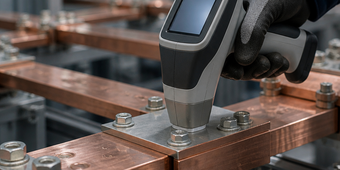
That’s also why plating thickness should be measured by XRF at the joint face rather than elsewhere on the part, a point also covered in Every Manufactured Part in a Data Center UPS.
Ask this: Is the tin thickness specified for the joint’s operating temperature and expected service life, or is it simply a standard plating callout?
Silver: Low Resistance Justifies the Cost
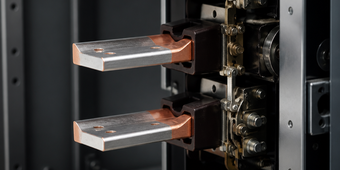
Silver is used where the contact interface has to stay conductive as temperature rises or where the connection moves repeatedly in service. Unlike tin or bare copper, silver does not build the same resistive oxide film, so contact resistance stays more stable at elevated temperature.
That makes it a strong fit for sliding contacts such as breaker stabs and plug-in connections. ABB specifies silver for those applications and limits tin to static joints, where repeated racking would wear the softer finish too quickly.
The tradeoffs are environmental exposure and cost.
Silver reacts with hydrogen sulfide to form silver sulfide, which can increase contact resistance. That is one reason ASHRAE’s guidance for data center environments includes limits on silver corrosion in G1-rated spaces.
Material cost matters, too. Silver has risen sharply from its 2024 average, and the cost scales directly with plating thickness and surface area. On large copper busbar assemblies, that can turn a seemingly small finish decision into a meaningful cost difference.
The question, then, is less whether silver is “better” than tin and more whether the application needs what silver is good at: low resistance at elevated temperature and durability in repeated-contact applications.
Best fit: Sliding contacts, plug-in stabs, and hotter joints where stable contact resistance justifies the added material cost.
Nickel: The Layer Doing the Work Underneath
Nickel is rarely the contact finish you’re trying to create on a busbar. More often, it’s there to control what happens between the base metal and the finish above it.
Under tin, a nickel layer slows the copper-tin reaction by replacing it with the much slower-growing Ni3Sn4 intermetallic. That helps preserve the free tin layer longer at temperature and can also reduce tin whisker risk.
Under silver, nickel acts as a diffusion barrier that keeps copper from migrating through the silver and oxidizing at the surface. On brass terminals, it serves a similar purpose by keeping zinc from reaching the contact interface.
A typical plating stack is base metal, 1.3 to 2.5 µm of nickel, then the final contact finish.
As a stand-alone contact surface, nickel is less forgiving. Its oxide is hard, and its conductivity is much lower than copper’s, so it generally needs more contact force than a typical bolted joint is designed to provide. On aluminum busbar, though, nickel also plays an adhesion role: after zincate treatment, a nickel strike helps tin or silver bond to the aluminum surface.
Behind the finish: Nickel usually isn’t chosen for what the contact surface needs to do. It’s chosen to control diffusion, adhesion, and long-term stability underneath it.
Bare Copper: Best for Cool-Running Joints
Bare C11000 copper can work well where joints stay cool and the operating environment is controlled. Without plating, though, the contact surface depends more heavily on cleaning, joint compound, and assembly quality because copper oxide builds resistance as temperature rises.
IEEE C37.20.2 also gives unplated copper joints a lower allowable temperature than silver- or tin-surfaced joints: 70 °C total versus 105 °C. In higher-current applications, that lower temperature limit can mean using more copper to carry the same load.
That changes the economics. Bare copper avoids plating cost, but it can shift cost back into conductor size, assembly preparation, or thermal margin.
Tradeoff to watch: Eliminating plating may reduce component cost, but it can also increase the amount of copper or installation control needed to keep the joint within temperature limits.
What to Put on the Drawing
A finish callout that says only “tin plate” or “silver plate” leaves too much open to interpretation.
For busbar plating, the drawing should define the finish and governing standard, minimum thickness, where that thickness is measured, any required underlayer, and the expected continuous joint temperature.
Those details belong together because they affect each other. Tin thickness means something different on a cool static joint than on one running near its temperature limit. A nickel underlayer can change how long the finish lasts. And measuring plating away from the actual contact face can tell you very little about the surface that carries current.
MES’s power distribution and critical power page lists the busbar materials and plating ranges used across these applications, while the transformers and switchgear page covers primary bus and bus stabs.
A more complete callout includes: finish, standard, minimum thickness, measurement location, underlayer, and expected operating temperature.
The Best Plating Choice Starts With the Joint
There isn’t one “best” busbar plating.
Tin makes sense for many static bolted joints, especially where cost or sulfur exposure matters. Silver earns its place where contact resistance needs to stay low at higher temperatures or through repeated connection cycles. Nickel usually does its most important work underneath another finish. Bare copper can still be the right answer when the joint runs cool enough.
Joint temperature, contact motion, environment, expected service life, and the base material all affect how a finish performs. Those factors also determine whether the plating thickness on the drawing is adequate or simply familiar.
That is the larger sourcing point. A plating callout may occupy one line on a drawing, but it can affect conductor size, thermal performance, service life, inspection, and cost.
The strongest specification is the one that reflects what will happen at the contact surface once the equipment is carrying current, not just what is easiest to put on the print.
Frequently Asked Questions
What is the best plating for copper busbar?
It depends on the joint. Tin suits static bolted joints and sulfur-bearing air at low cost. Silver suits sliding contacts and hot joints where stable contact resistance justifies the price. Both allow a 105 °C joint under IEEE C37.20.2, against 70 °C for bare copper.
Why is nickel used under tin or silver plating?
Nickel is a diffusion barrier. Under tin, it slows intermetallic growth so the tin lasts longer at temperature. Under silver, it stops copper diffusing to the surface. On brass, it keeps zinc from reaching the contact. A typical underlayer is 1.3 to 2.5 µm.
How thick should tin plating be on a busbar?
About 3 to 8 µm per ASTM B545 for static joints that run cool, and 8 to 20 µm where the joint runs hot for a long service life. The callout should name the measurement location at the joint face, checked by XRF.
Does tin plating wear out on a busbar?
Yes, at temperature. Tin reacts with copper to form Cu6Sn5 and Cu3Sn intermetallics that consume free tin over time, and the reaction speeds up as joint temperature rises. A nickel underlayer slows it.
Is silver-plated busbar worth the cost for data center power distribution?
For plug-in stabs, breaker contacts and joints running near their temperature limit, usually yes. For static bolted joints in busway and battery cabinets, tin at the right thickness generally meets the requirement at a fraction of the cost.
MES manufactures plated C11000 copper busbar, bus stabs and joint blocks across eight countries, with engineering and quality staff inside the supplier factories. We’ve held ISO 9001 certification since 2009. Send a busbar or bus stab drawing and we’ll tell you which plating callouts can be held as drawn. Quotes take three to five business days..