The components behind the grid — and the AI build-out on top of it.
Manufacturers of switchgear, busway, transformers, cooling systems and battery storage build with our
parts — across three continents.
MES delivers the die cast, machined, forged and extruded components that critical power equipment is made
of, with our own engineers inside the supplier factories in eight countries, on the day your parts run.
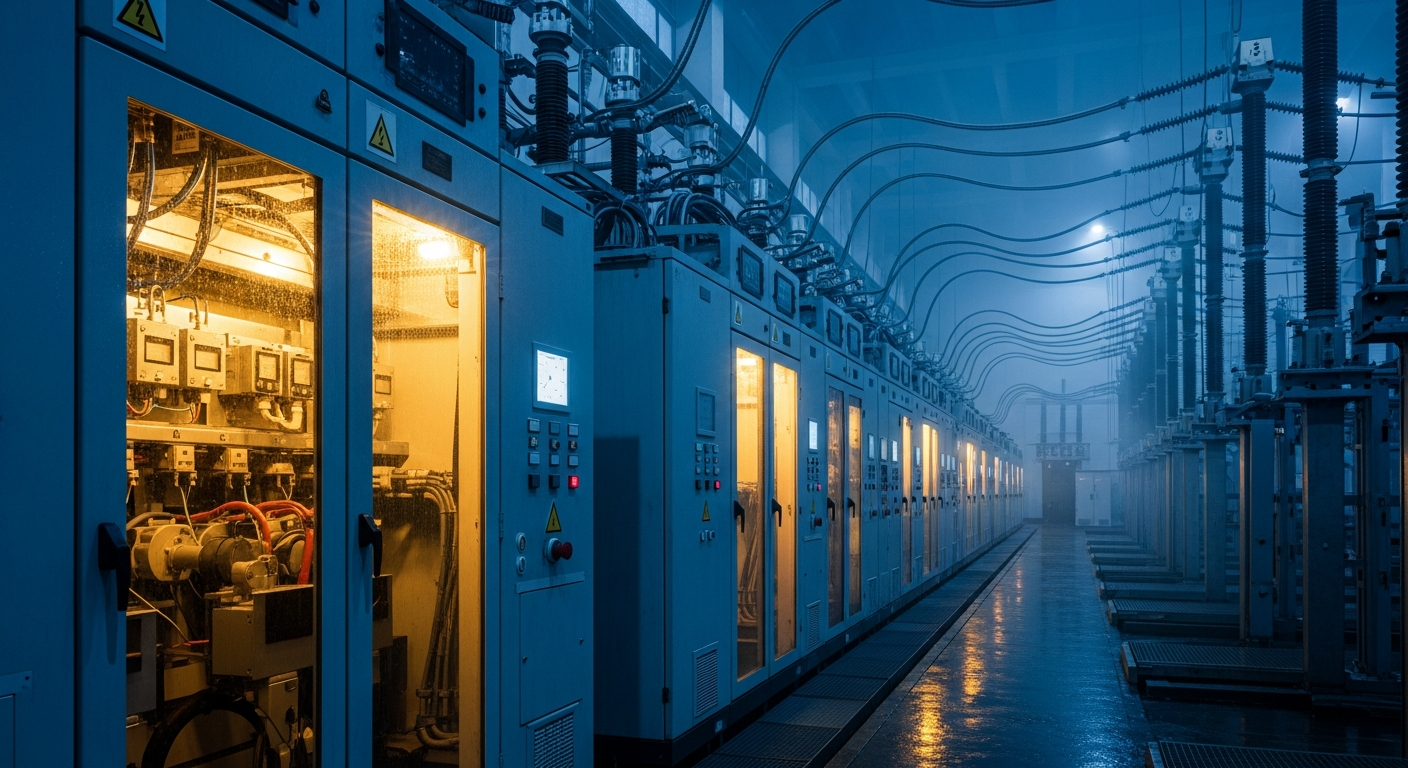
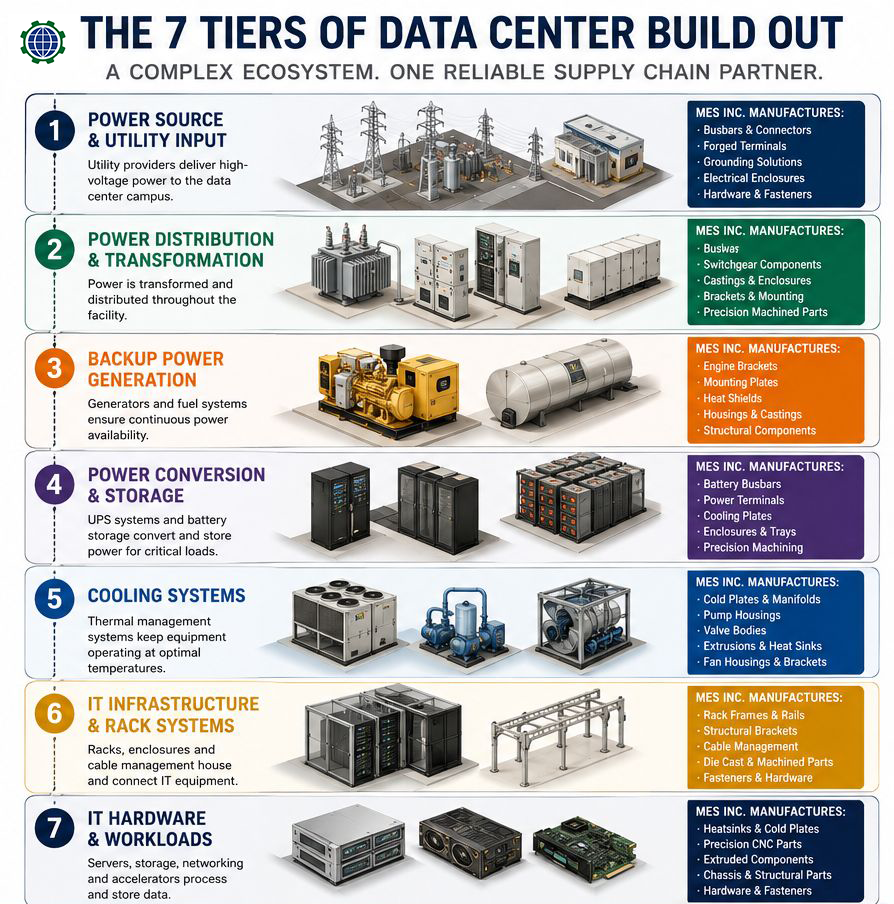
A data center is a compressed copy of the grid, built indoors on a two-year schedule. Roughly a third of planned 2026 openings slipped, and it was electrical equipment that held them up — not chips. Here’s where our components sit in it.
Transformers and switchgear move power through
the building.
Machined copper conductors for medium-voltage breakers
— a thousand parts recovered in eight months when a supplier shutdown hit an active program. Plus
mechanism housings, cradles and enclosure framing.
Engine and alternator brackets, exhaust manifold
flanges, radiator coil frames and canopy framing. We supply the metal around the engine, not the
engine.
Most component suppliers appear in one tier, which is why a data center build touches a dozen of them.
Sourcing across all seven from one partner means one qualification, one set of documentation, one
planner — and one number to call when a tier goes quiet.
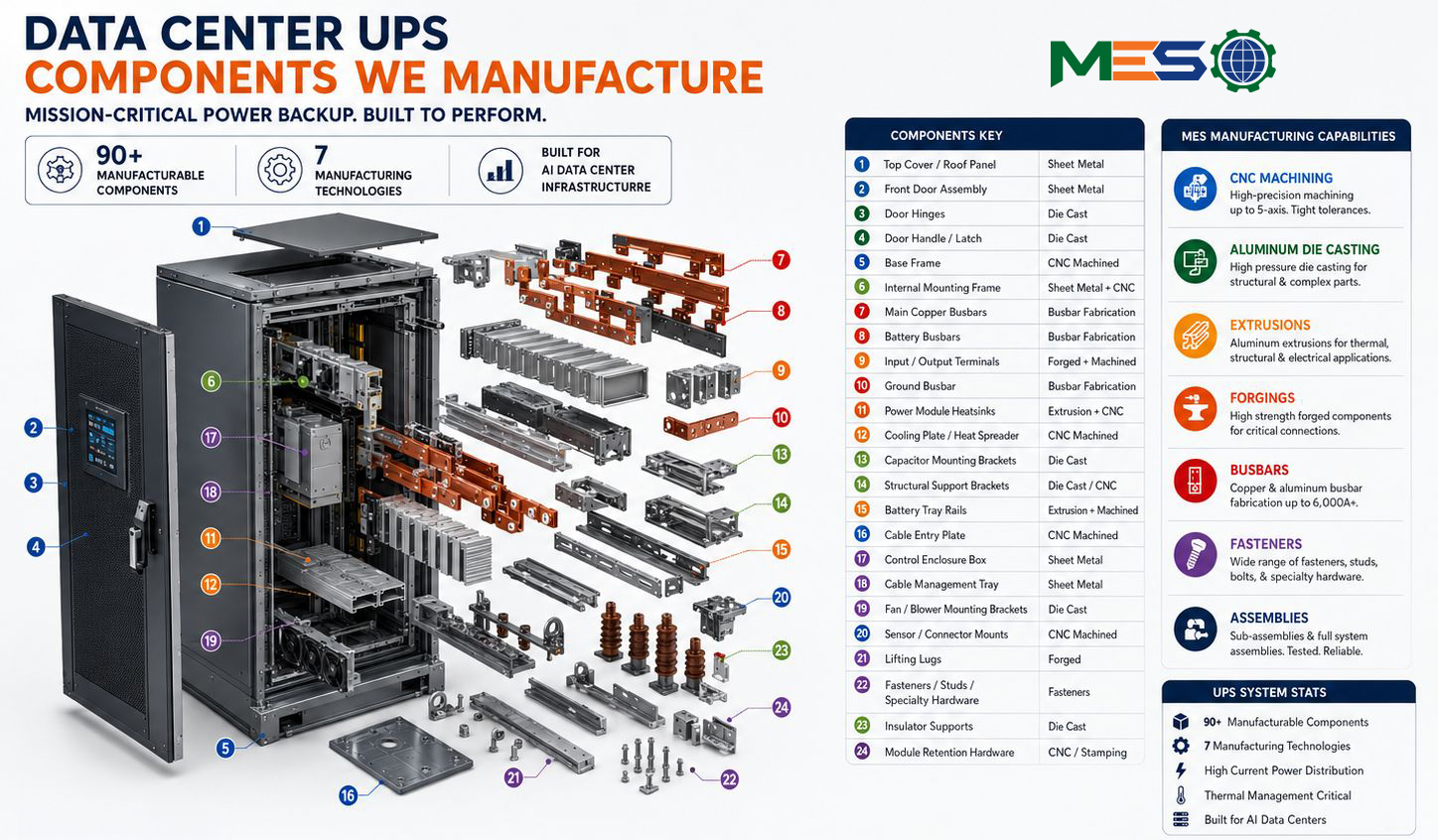
90+ Components in a UPS Cabinet. We Make Most of Them.
A modular UPS is a dense stack of power electronics inside a structure that has to carry current, manage heat, and let a technician swap a module without taking the system down. The electronics come from the OEM. Almost everything holding them is machined, cast, extruded or forged.
Main copper busbars · battery busbars · ground busbar · input and output terminals
Machined C11000 and plated at the joint face, not on the flat. Terminals are forged then machined —
grain flow following the load path, certified per heat lot. Busbar fabrication to 6,000 A and above.
Thermal
Power module heat sinks · cooling plates and heat spreaders · fan and blower mounting brackets
Heat sink bases are extruded then machined flat under the module footprint. That sequence matters:
machining after straightening is what holds the flatness, and a base that is flat but rough raises
junction temperature as surely as one that is bowed.
Extruded rails and die cast brackets. Retention hardware carries a hot-swap requirement most enclosure
parts do not — the mating faces have to stay in tolerance after dozens of insertion cycles.
Enclosure and Structure
Base frame · internal mounting frame · top cover · doors · hinges and latches · cable entry plates ·
cable management trays · control enclosure · lifting lugs
CNC machined base frames, die cast hinges and latches rated for cycle life, extruded framing, forged
lifting lugs.
Seven component families. Four processes. One
purchase order.
Most of these parts are sourced separately, from suppliers who each do one of them. That is four
qualification cycles, four audits and four sets of documentation for one cabinet.
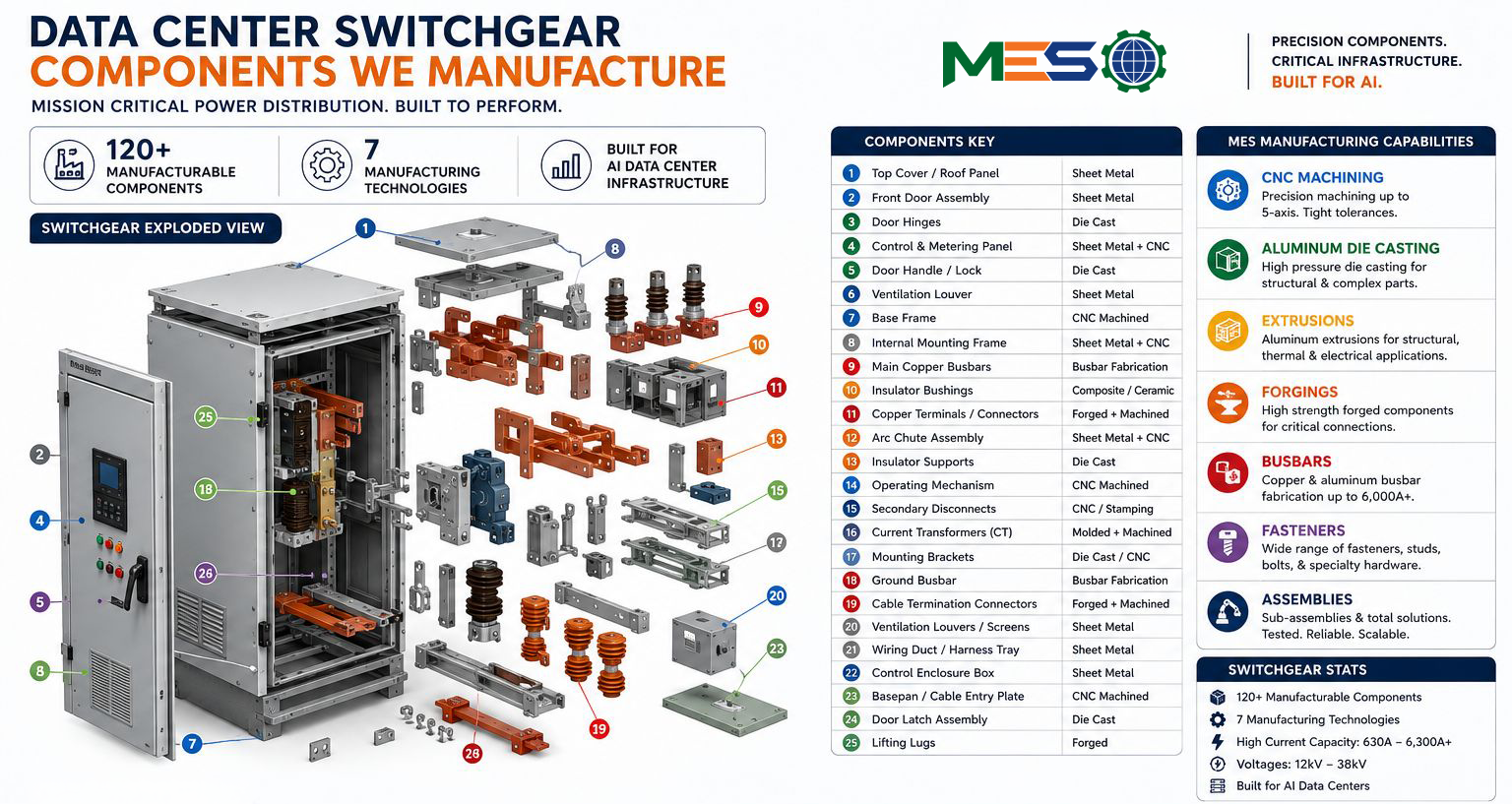
120+ Components in a Switchgear Cabinet. All Five Processes.
A medium-voltage switchgear cabinet is the assembly where every process MES runs appears inside one enclosure — die casting, investment casting, forging, extrusion and machining. 630 A to 6,300 A, 12 kV to 38 kV, and roughly 120 manufacturable parts before the interrupters go in.
CNC machined mechanisms and die cast supports. The tolerance that decides whether a breaker behaves
the same at operation four thousand is the internal stack — pivot bores to mounting face — not the
outside profile.
Insulation and Instruments
Insulator bushings · current transformers · insulator supports
Composite and ceramic bushings are sourced. The mounting hardware around them is die cast and
machined.
Enclosure and Structure
Base frame · basepan and cable entry plate · internal mounting frame · doors and hinges · control and
metering panel · ventilation louvers and screens · wiring duct and harness tray · control enclosure ·
door latches · lifting lugs
Machined base frames and basepans, extruded framing, die cast hinges and latches, stamped louvers,
forged lifting lugs.
One cabinet. Five processes. Five qualification
cycles — or one.
That is the argument for consolidation, and switchgear is where it is most obvious. Sourcing the mechanism housing, the trip latch, the operating shaft, the framing and the bus from five different suppliers means the first shipment is gated by the slowest of five qualifications rather than the average.
Nobody changes a component supplier because things are going well. They change because a plant closed, a
lead time doubled, or a part that was never a risk suddenly became one. That is the call we usually get.
Here is what happened next.
MES // Field-Proven
Case Study Outcomes
Verified
250+
Qualified Suppliers
One relationship to manage them
0
Line Stoppages
While replacing an incumbent supplier
13×
Volume Scaled
Without requalifying the part
3
Processes on One Program
Die cast, machined, plated to spec
DOC.REF_849.22A
Eaton — a thousand parts, eight months, no line stoppage
A sudden manufacturing shutdown hit Eaton’s VCP-W medium-voltage circuit breaker program. MES qualified
replacement supply and cleared a backlog of nearly one thousand parts in under eight months, taking annual
output from 3,000 units to more than 40,000.
The parts were high-tonnage aluminum die castings with selective tin and silver plating. We nearsourced them
to a partner in Eaton’s own backyard — cutting lead times and removing tariff exposure in the same move.
Eaton — twenty-plus locations, one inventory program
Eaton operates in more than 170 countries. MES now runs a fully managed inventory program across twenty-plus
of their facilities, holding stock against their build schedule rather than our shipping schedule.
Acuity Brands — twelve weeks of working capital released
The component was right. The supplier was qualified. The tooling was dialed in. And twelve weeks of inventory was sitting behind it because nobody had revisited the program since it launched. MES restructured it and released the capital without touching delivery performance.
Why Power Equipment Manufacturers Change Suppliers
Because the parts that stop a build are never the ones anyone was watching.
A core assembly gets a sourcing manager, a dual-source plan and a quarterly review. A twelve-dollar bracket
gets a purchase order. That allocation is rational on cost and backwards on schedule — and it is why plants
go down waiting on hardware nobody had on a risk register.
We make the parts nobody was watching. Five processes, one relationship, one set of documentation.
01
WE REVIEW THE DRAWING BEFORE THE TOOL IS CUT
A plating callout with no thickness. A bore that cannot hold as-cast. You hear it in five business days,
at no cost, while it is still a print.
02
WE MEASURE IN THE PLANT THAT MADE IT
CMM at source on the parts that ship — not on your dock, and not on a first article made under
conditions the production run will never see.
03
WE OWN THE INVENTORY UNTIL YOU DRAW IT
Stock in Columbus, Monterrey and Poland. Your line pulls in days, on min-max or consignment, from
inventory on our balance sheet.
04
WE EMPLOY THE ENGINEERS IN THE FACTORY
Eight countries, our own payroll, on the floor the day your parts run. Not a quarterly audit the factory
prepared for.
CAPABILITIES
What We Make, and How
A single medium-voltage switchgear cabinet needs all five processes. Sourcing them separately means five
qualification cycles, five audits and five sets of documentation.
Die Casting
Mechanism housings, enclosures, tap-off boxes, cooling plates, fan shrouds. Aluminum and zinc, thin
wall, EMI shielding inherent.
Investment Casting
Trip latches, contact carriers, valve bodies, pump volutes, exhaust flanges. Near-net shape in 17-4PH,
CF8M and high-temperature alloys.
CNC Machining
Copper busbar, bushing wells, cold plates, manifolds, heat sink bases, turret flanges. Multi-axis in
copper, brass, aluminum and stainless.
Forging
Lifting and jacking lugs, operating shafts, terminal lugs, anchor rods. Grain flow following the load
path, certified per heat lot.
Extrusions
Radiator panels, heat sinks, busway housings, cabinet framing, rack rails. Custom profiles, precision
straightened where the standard is not tight enough.
METALLURGY
The Right Metal for the Job
This is the sector where material choice is an electrical decision, not just a structural one.
Cu
Copper
C11000 at 100% IACS. Busbar, bus stabs, bushing studs, cold plates, ground pads — plated at the joint face, where the current actually crosses.
Cu+Zn
Brass
C36000 where machinability governs over conductivity. Terminal studs, port fittings, quick-disconnect bodies.
Al
Aluminum
6101-T6 for conductors. 6063 and 6005A for housings and structural framing. A380 for die cast enclosures. 6061 for machined thermal parts.
Zn
Zinc
Zamak 3 and 5 for intricate cabinet hardware and cycle-rated latches. Note it is 2.4 times the density of aluminum, which surprises buyers on freight.
Fe
Steel & Stainless
Galvanized forgings for outdoor load-bearing hardware. 17-4PH for high-cycle fatigue. CF8M and 316 where corrosion or hot oil demands it.
STRAIGHT ANSWERS
Are We a Fit? Here Is Both Answers.
Procurement teams are told yes constantly. The fastest way to be believed about what we can do is to be highly
specific about what we cannot.
MES // SYS.EVAL
Fit Assessment
Multi-process consolidated assemblies
Global capacity scaling & nearsourcing
Live shortage recovery / supplier failure
30-year legacy parts & drawings
Domestic melt & pour requirement
Very low-volume hard-tooled parts
Authorized
FORM_QA.7B
Where We Are The Right Answer
[ FIT.CRITERIA_TRUE ]
01.
Capacity that scales globally.
Die casting, investment casting, forging, extrusion and CNC machining under one contract, across eight countries, with our own engineers on the floor.
02.
Live shortages and supplier failures.
When you need someone qualified against a live shortage rather than a leisurely planning cycle.
03.
Consolidating complex assemblies.
When one assembly needs three or four processes and you are managing three or four relationships to get it.
04.
Revisiting legacy hardware.
When the part has to be right for thirty years and nobody has looked at the drawing since it was released.
Where We Are Not
[ NO_FIT.CRITERIA_FALSE ]
01.
Domestic melt and pour.
If your specification requires it, a domestic mill wins. We will say so on the first call and point you toward one.
02.
ITAR and NQA-1 nuclear.
Not our lane. Pretending otherwise costs you six weeks of schedule and significant qualification burden.
03.
The parts inside the parts.
Core laminations, windings, bushings, power electronics. We make the custom structural metal around them.
04.
Very low volume hard-tooled parts.
Below a few hundred pieces a year, the tooling amortization rarely works in your favor. We will tell you.
Most of the time none of these negative constraints apply, and we get on with it.
WHY PARTNER WITH US
The MES Difference
Conductivity for power components
Copper and brass parts plated and verified at the joint face, not on the flat.
Safety-critical dimensional accuracy
CMM at source, on every lot — not a first article and a hope.
Sealed, shielded enclosures
Die cast housings with EMI shielding and IP-rated sealing.
Traceability that survives an audit
Heat-lot certification captured at the mill, not reconstructed on receipt.
Capacity for a booming sector
Eight countries · 250+ qualified suppliers · 3,000+ audited sources.
Consolidated, dependable supply
Five processes, one partner, one planner · 98%+ on-time delivery.
Cost pressure on high-volume parts
20 to 55% savings through global and nearshore sourcing.
ECOSYSTEM
Markets We Serve
Grid and substation
transmission, distribution, protection
Data center critical power
UPS, busway, PDU, rack infrastructure
Data center thermal
direct-to-chip, CDU, immersion, air handling
Energy storage
grid-scale BESS and data center ride-through
Power conversion
inverters, PCS, motor drives
Standby generation
diesel, gas and fuel cell ancillary content
Renewables
solar mounting, tracker hardware, inverter housings
EV charging
power cabinets, heat sinks, connector cold plates
FAQ
ELECTRIFICATION & ENERGY FAQS
Across four equipment families: transformer and switchgear hardware including bushing wells, relief valves, forged lifting lugs, radiator sections and mechanism housings; critical power components including copper busbar, bus stabs, busway housings, tap-off boxes and UPS enclosures; liquid cooling components including cold plates, CDU manifolds and heat sinks; and storage and standby components including cabinet framing, module end plates, interconnect busbar and generator enclosure hardware.
Yes, across the full power and cooling chain. Medium-voltage switchgear and unit substations, UPS enclosures and internal busbar, overhead busway and tap-off boxes, rack PDUs and framing, battery cabinet interconnect, standby generator enclosure content, and direct-to-chip cold plates and CDU manifolds. A hyperscale campus contains a compressed copy of the grid, and MES makes hardware at every stage of it.
Quote in three to five business days on a complete drawing package, and manufacturability feedback in five. Tooling and first article timing depend on the process — full lead times are on each equipment sub-page. Once a part is qualified, we stock it in Columbus, Monterrey or Poland so your line pulls in days rather than against a thirty-day ocean transit.
Die casting where the enclosure needs integrated features cast in — mounting bosses, ribs, EMI shielding and sealing surfaces in one part. Sheet metal where the geometry is simple, volumes are low or the tooling cannot be justified. Die casting usually wins on assembly content: a cast housing with cast-in features replaces a fabrication with brackets, welds and fasteners.
Extrusion for constant cross-section profiles with high aspect ratio fin arrays, in long lengths at low tooling cost. Die casting where the part has features in more than one plane, or where the fin geometry cannot be extruded. Many parts use both — an extruded profile with die cast end features, or an extruded base machined for a specific footprint.
Forge anything carrying a rated load or cycling under stress — grain flow follows the load path, and the part is certified per heat lot and NDT inspectable. Investment cast anything whose value is in its geometry: complex internal passages, near-net shape, and features that would otherwise take multiple machining setups.
Duty on covered copper articles is now assessed on the full customs value of the imported part rather than on its copper content. A machined and plated busbar or bushing stud carries substantial processing value beyond the raw metal, so the dutiable base grew accordingly. Melt-and-pour documentation and origin routing now materially affect landed cost.
MES is headquartered in Columbus, Ohio with nearshore manufacturing in Monterrey, Mexico, supporting Buy American preferences and domestic-content requirements. Where a specification requires domestic melt and pour, we will say so directly and point you toward a domestic source rather than quote around it. MES has been ISO 9001:2015 certified since 2009 and is NMSDC minority-certified.
GET STARTED
Send Us One Drawing.
Quote in 3–5 business days. Full cost breakdown
including tooling, piece price, and logistics.
Manufacturability feedback in 5. A plating callout
with no thickness, or a bore that cannot hold as-cast — you hear it while it is still a print.
Straight answers. We will tell you what will hold as
specified, what will not, and where we are the wrong supplier entirely.