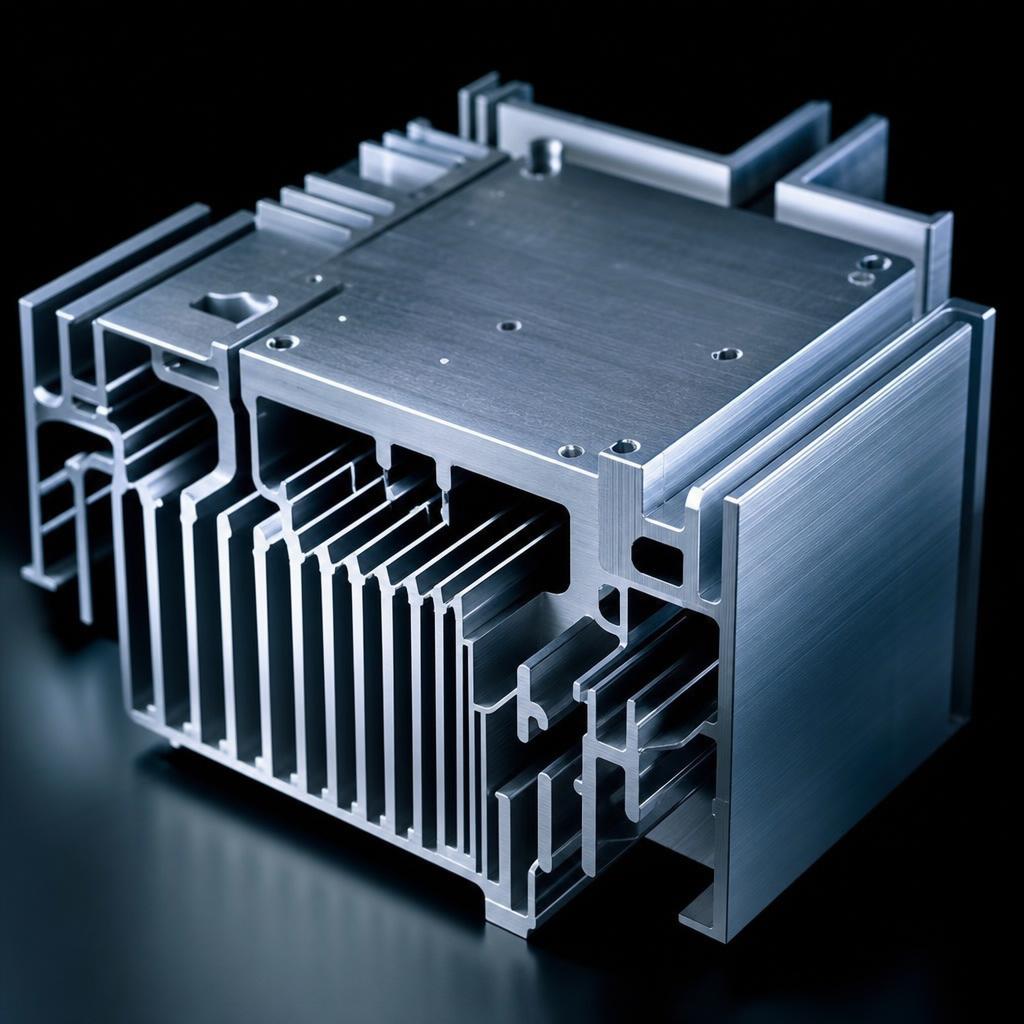

MES, Inc.
CRITICAL

Power Distribution & Critical Power

Machined copper and cast enclosure hardware for critical power.

MES machines, extrudes, casts and forges the metal components inside UPS, busway and rack distribution equipment — in eight countries, with our own engineers on the floor.

What Changed

5 Pressures on Critical Power Sourcing

Five pressures on critical power sourcing that were not there three years ago.

01

Rack density

Rack-level draw multiplied with AI compute. A busway sized for a conventional hall is undersized for an AI hall.

02

Machining capacity, not copper

Copper is available. The operators and equipment to hold 0.05 mm flatness and plating quality on it are booked — which is why lead times moved further than prices.

03

Copper cost basis

Since April 2026, Section 232 duty on covered copper is assessed on full customs value, not metal content.

04

Joint integrity

Bolted aluminum joints creep under thermal cycling. Plating, torque and belleville hardware are the failure mode, and they are set on the drawing.

05

Modularity

Prefabricated skids moved assembly upstream. A part that was fitted on site now has to arrive correct.

Why MES

Why Critical Power Manufacturers Work With MES

Because a bus joint conducts through its plating, not its base metal. A bar bowed 0.2 mm at the joint face makes contact across a fraction of its nominal area, and the resistance rise shows up as heat years later.

We measure every lot at source. We review the drawing before the tool is cut.

Certified & Global

  • ISO 9001:2015 since 2009
  • IATF 16949
  • NMSDC Minority-Certified
  • Eight countries
  • Supplying global power management manufacturers including Eaton

WE MEASURE THE JOINT FACE, EVERY LOT

Flatness to 0.05 mm and edge condition where the current crosses. First article on 100% of features, then 5 pieces per lot.

WE REVIEW THE DRAWING FIRST

A plating spec with no thickness. 6063 called out where 6101 is needed. DFM feedback in 5 business days, at no cost.

WE MEASURE PLATING AT THE JOINT

Not on the flat. Thickness verified at the contact face by XRF, per lot.

WE EMPLOY THE ENGINEERS IN THE PLANT

Same country, same floor, the day your parts run. Not a quarterly audit the factory prepared for.

APPLICATIONS

Three Applications. One Copper Capability.

Wherever current crosses a bolted joint and has to survive thirty years of thermal cycling, the same machined and plated copper applies.
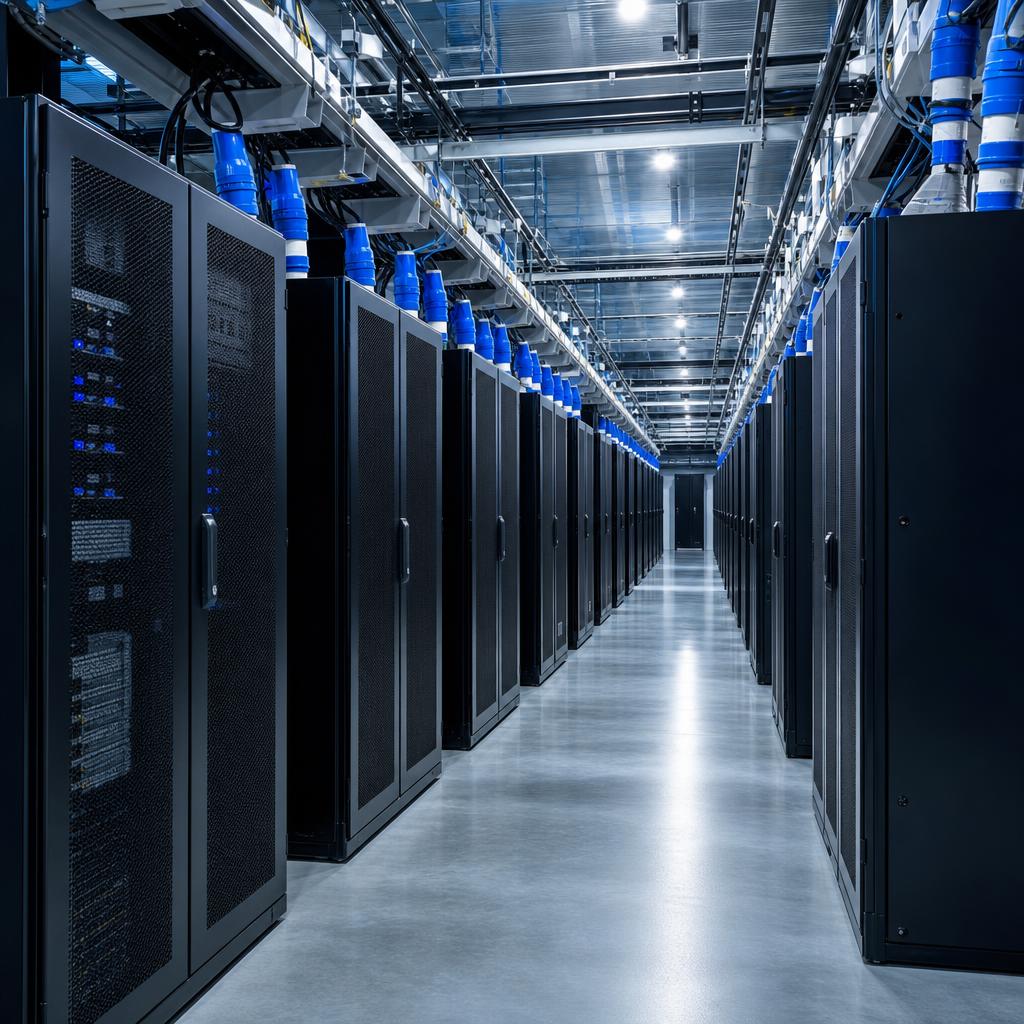
DATA CENTER CRITICAL POWER
01

DATA CENTER CRITICAL POWER

A third of planned 2026 openings slipped, and electrical equipment held them up — not chips.

Components

Busbar · bus stabs · joint blocks · busway housings · tap-off boxes · UPS enclosures · IGBT heat sink bases · PDU bodies

Materials

C11000 copper · 6101-T6 · 6063-T6 · A380 aluminum · Zamak 3/5

The Spec That Matters

0.05 mm flatness at the joint face, called out separately from the profile tolerance.

Vertiv · Starline · E+I Engineering · Legrand · Anord Mardix · APC · Piller
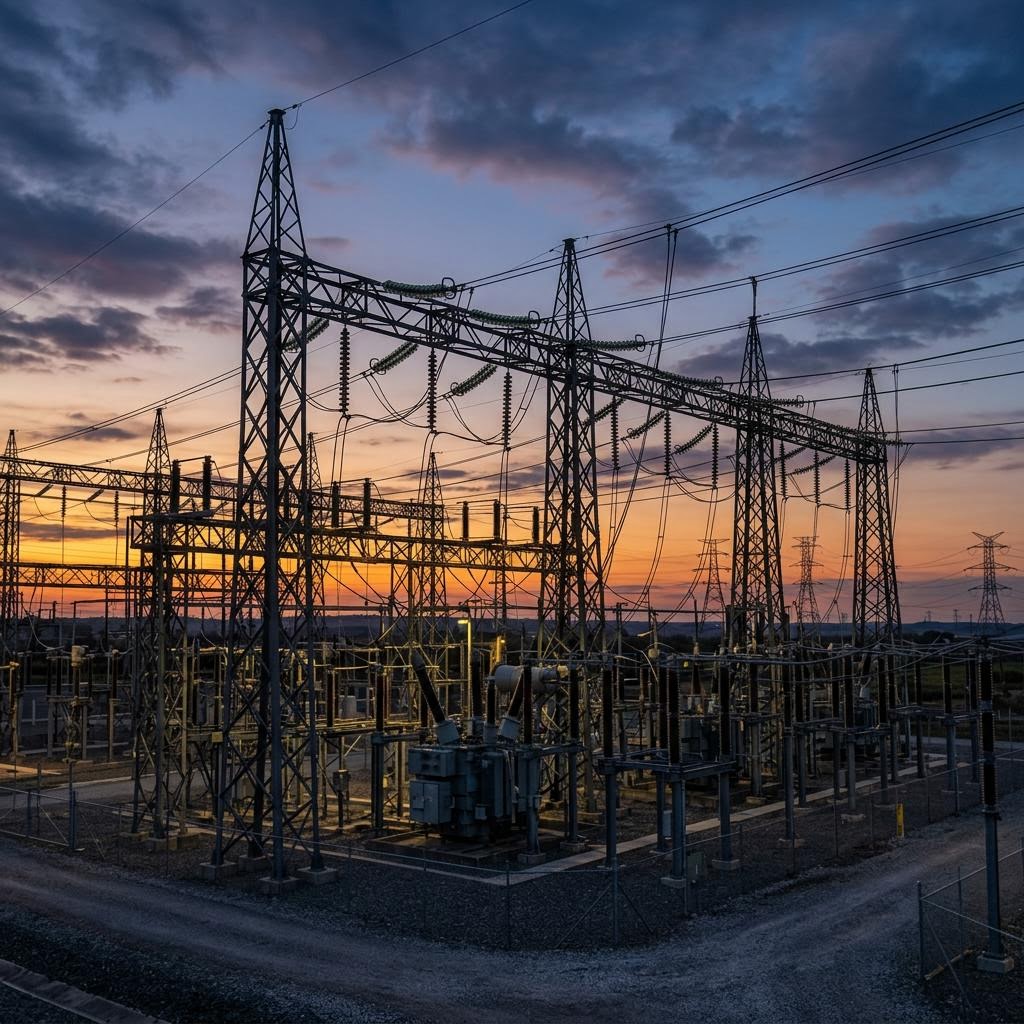
RACK & ENCLOSURE INFRASTRUCTURE
02

RACK & ENCLOSURE INFRASTRUCTURE

The frames, rails and cable management that hold IT equipment and route power to it.

Components

Rack frames · mounting rails · structural brackets · cable trays · blanking panels · leveling feet · seismic anchors

Materials

6063-T6 · 6005A-T6 · A380 aluminum · Zamak zinc

The Spec That Matters

±0.4 mm cumulative U-position accuracy over 42U, against a 1.3 mm/m extrusion standard.

Rittal · Panduit · Chatsworth Products · nVent · Great Lakes · Legrand
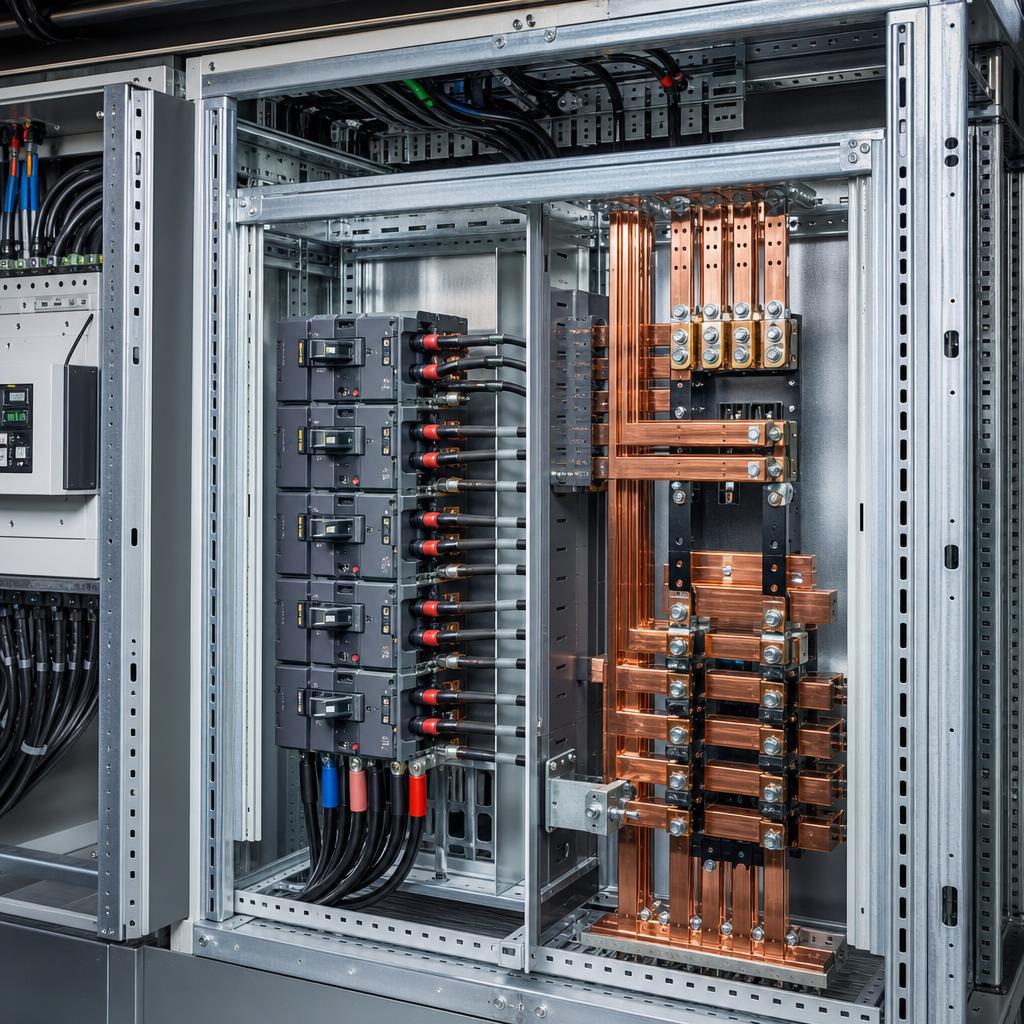
INDUSTRIAL & COMMERCIAL DISTRIBUTION
03

INDUSTRIAL & COMMERCIAL DISTRIBUTION

Switchboards, panelboards and busway outside the data center. Same joints, longer runs.

Components

Conductor bar · splice plates · plug-in contacts · end feed and elbow bodies · breaker pans · neutral and ground bus

Materials

C11000 copper · 6101-T6 aluminum · A380 aluminum

The Spec That Matters

creep management on aluminum joints — belleville hardware specified on the assembly.

Eaton · Schneider Electric · Siemens · ABB · Powell Industries · Myers Power Products

Battery cabinet interconnect uses the same machined and plated copper.

See Energy Storage & Backup Power
Capability Limits

What We Can Hold

What we hold and where the limits are. If your part sits outside this, send it anyway.
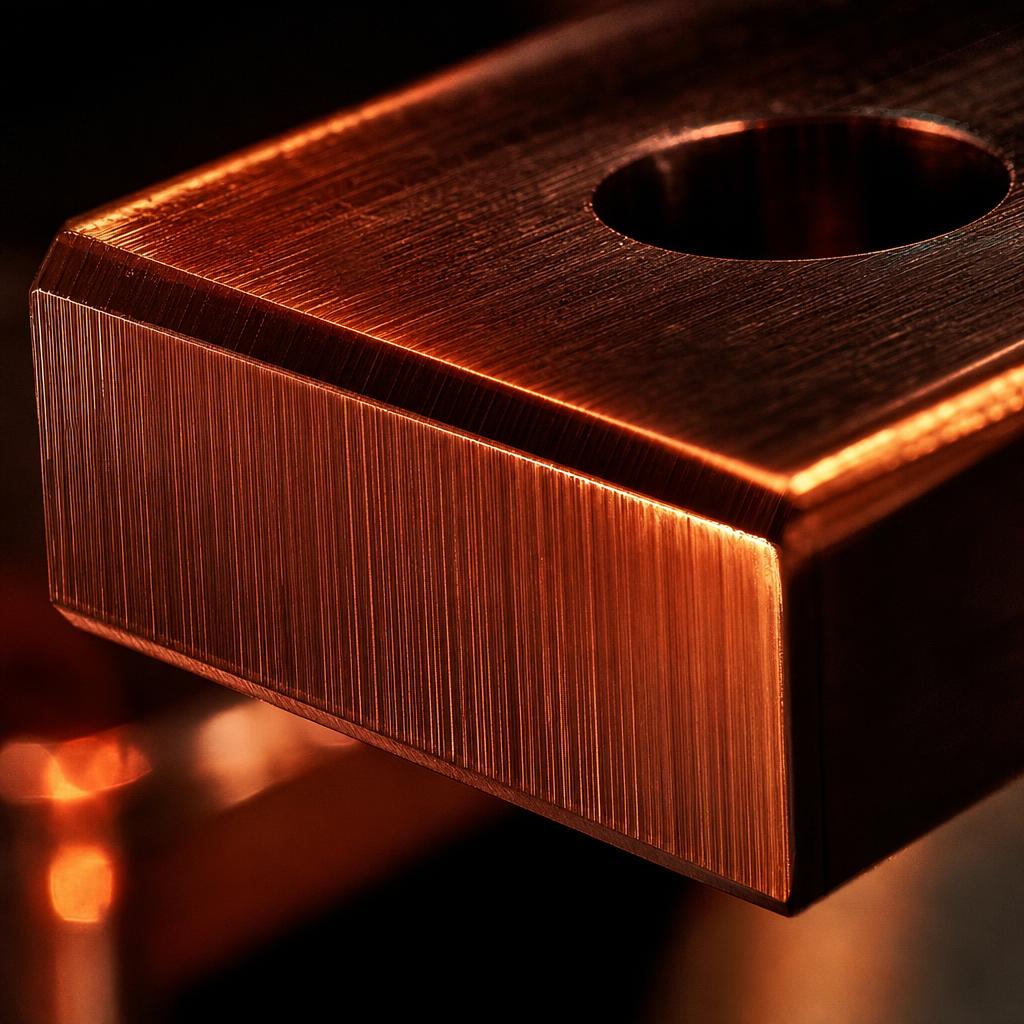
Machined copper busbar limits

01

Busbar & Conductors

0.05 mm
Flatness at joint face
over the bolted area
up to
3,000 mm
Machined length
5 to 13 µm
Silver plating
at the joint face
up to
6,300 A
Ampacity
630 A to 6,300 A

Standard Specifications

  • Copper bar thickness 3 mm to 25 mm
  • Copper bar width 20 mm to 250 mm
  • Edge condition 0.4 mm break, burr-free, specified separately
  • Hole position tolerance ±0.10 mm
  • Tin plating 5 to 15 µm at the joint face
  • Voltage class served 600 V to 38 kV
Extrusion and casting limits

02

Extrusion, Casting & Enclosure

0.05 mm
Heat sink flatness
under the module footprint, 0.8 µm Ra
0.5 mm/m
Rack & PDU straightness
over 2,200 mm
up to
300 mm
Extruded profile
circumscribing circle
up to
4,400 ton
Die casting presses
5 g to 40 kg parts

Standard Specifications

  • Extruded length up to 6 m · precision straightened to 0.5 mm/m
  • Extrusion wall, minimum 1.2 mm on 6063 · 1.5 mm on 6005A
  • U-position accuracy, rack rail ±0.4 mm cumulative over 42U
  • Die cast wall, minimum 1.5 mm aluminum · 0.8 mm zinc
  • Investment casting 10 g to 50 kg · ±0.13 mm on the first 25 mm
  • Annual volume 500 to 500,000 pieces per part number
Quality

How We Prove It Before It Ships

Every number on the drawing has to be measured by someone, somewhere. We do it in the supplier's plant, on the parts that ship — not on your dock, and not on a first article that was made under conditions the production run will never see.

Here is what that looks like in practice.

First article
100% of features AS9102 format
Production
5 pieces per lot on joint faces and hole positions · CMM at source
Plating thickness
XRF at the joint face per lot, not on the flat
Plating adhesion
ASTM B571 bend or tape test, per lot
Flatness verification
Across production lot not the first article alone
Metrology
Traceable to NIST calibrated annually
Material
Mill certificate per lot alloy verified by XRF on receipt
Conductivity verification
Eddy current on 6101 extrusions, per lot
Contact resistance
Micro-ohm measurement available on request
Documentation
PPAP Level 3 standard Level 4 available · 10 year retention
Schedule

Lead Times

Step 01

3 to 5 business days

Quote turnaround

on a complete drawing package

Step 02

5 business days

DFM feedback

before tooling · no cost

Step 03

2 to 4 weeks

Prototype, machined busbar

Step 04

6 to 10 weeks

Extrusion die

Step 05

8 to 16 weeks

Hard tooling, die cast

Step 06

2 to 3 weeks

First article inspection

from tool approval

Step 07

6 to 10 weeks

Production, tooled part

Step 08

2 to 5 days

From stock

from Columbus, Monterrey or Poland

Scroll
Components We Engineer & Deliver

Four Assemblies.

Precision CNC machining, aluminum extrusion, high-pressure die casting and forging.

Busway & Busbar

Three requirements get under-specified: plating with a standard and a test location, flatness at the joint, and alloy designation where conductivity matters.

Part by Part

Copper conductor bar

CNC machined C11000, 100% IACS — 3 to 25 mm thick, to 250 mm wide

Aluminum conductor bar

Extruded 6101-T6, machined at joint faces — 55 to 57% IACS

Busway housing sections

6063-T6 extrusion to 6 m, straightened 0.5 mm/m

Joint block and splice plate

Machined copper or aluminum — 0.05 mm flatness at the joint

Bus stab and plug-in contact

Machined, 5 to 13 µm silver or 5 to 15 µm tin plated

Tap-off box housing

A380 die cast — 1.5 mm minimum wall

End feed and elbow bodies

Cast and machined

Hanger and seismic support brackets

Stamped and machined

UPS Systems

Each modular bay is a dense stack of power electronics. Heat sink flatness under the power module is the specification most often missed.

Part by Part

Enclosure frame and panels

Extruded and machined aluminum

DC link busbar

CNC machined C11000, plated — 3 to 16 mm thick

AC input and output busbar

CNC machined C11000, plated

IGBT heat sink base

Extruded then machined to 0.05 mm flatness, 0.8 µm Ra

Capacitor mounting bracket

A380 die cast and machined

Module chassis and hot-swap rails

Extruded and machined — 50 insertion cycles

Cable gland plate

CNC machined aluminum

Terminal lugs and connector bodies

Forged and machined, certified per heat

Power Distribution Units

Floor-mount, rack-mount and remote power panels draw on the same families. Straightness across a two-meter body is the spec most often left to the standard.

Part by Part

Floor-mount enclosure frame and panels

Extruded and machined aluminum

Rack PDU body

6063-T6 extrusion to 2,200 mm, straightened 0.5 mm/m

Outlet strip extrusion

Custom profile, 1.2 mm minimum wall

Main and branch bus assembly

CNC machined copper, plated

Breaker mounting pan

Die cast and machined — ±0.10 mm hole position

Neutral and ground bus

Machined copper, UL 467 where required

Metering panel frame

CNC machined

Door, hinge and latch hardware

Zinc die cast, 10,000 cycle rated

Rack & Enclosure

Extruded aluminum with cast and stamped hardware. U-position accuracy over a two-meter rail decides whether equipment mounts without shimming.

Part by Part

Rack frame and mounting rails

6063 extrusion — ±0.4 mm cumulative over 42U

Structural brackets and gussets

Die cast and stamped

Cable management arms and trays

Extruded and stamped

Blanking panels and airflow seals

Stamped

Leveling feet and casters

Machined

Seismic anchors and base hardware

Forged, certified per heat

Door frames, hinges and locks

Zinc die cast

Engineering Specifications

What Engineers Ask Us About Busbar Manufacturing

Five specifications decide whether a bus joint survives thirty years of thermal cycling. All five are set on the drawing.

6101-T6 runs 55 to 57% IACS. 6063-T6 runs roughly 53% and is intended for housings and framing. Substituting it costs ampacity you have to recover by increasing cross-section. Write the alloy and temper on the drawing.

Tin at 5 to 15 µm resists corrosion and adds contact resistance. Silver at 5 to 13 µm conducts better and galls under torque if thin. Specify a thickness, a standard and where it is measured — plating on the flat is not plating at the joint face.

The joint conducts through the area that actually touches. A bar bowed 0.2 mm across a 60 mm joint face contacts a fraction of its nominal area, and the resistance rise shows up as heat. Specify 0.05 mm flatness and edge condition at the joint, and state where it is measured.

Aluminum creeps under sustained bolt load and thermal cycling. A joint torqued at commissioning relaxes unless belleville washers maintain the load. Specified on the assembly rather than the component — but it decides whether the component performs.

Any deviation in the heat sink face leaves a gap the TIM has to fill, and TIM conducts far worse than aluminum. Specify 0.05 mm flatness under the module footprint and 0.8 µm Ra with it, verified across the lot. Flat but rough, or smooth but bowed, both raise junction temperature.

57% IACS

Conductivity of 6101-T6, the busbar alloy most often substituted wrong.

5 TO 13 µm

Silver plating thickness, measured at the joint face.

Copper or Aluminum Busbar?

Both are in production. The choice comes down to ampacity per unit area, weight and how the joints will be maintained.

C11000 Copper

100% IACS, carrying roughly 1.7 times the current of aluminum at the same cross-section. 8.9 g/cm³. Stable bolted joints with conventional hardware.

Materially more expensive and dutied on full customs value since April 2026.

6101-T6 Aluminum

55 to 57% IACS, so it needs roughly 1.6 times the cross-section for the same ampacity. 2.7 g/cm³ and cheaper per amp, which matters on long overhead runs.

Joints creep and need belleville hardware.

The Rule

Copper where space is constrained or maintenance access is poor. Aluminum on long runs where weight and cost dominate. MES machines copper and extrudes aluminum, so the decision can be made on engineering grounds.

Qualification

Where We Are Not the Right Answer

The fastest way to be believed about what we can do is to be specific about what we cannot.

Domestic melt and pour. If your specification requires it, a domestic mill wins and we should not be in the conversation.

ITAR-controlled work and DFARS specialty metal restrictions. Not our lane.

NQA-1 nuclear programs. The qualification burden is real and we do not carry it.

Insulation systems, epoxy coating and encapsulation. We machine and plate the conductor. The dielectric system comes from you or a specialist.

Breakers, meters, relays and monitoring. OEM-supplied.

Volumes under 500 pieces a year on a hard-tooled part.

Capabilities

Five Processes. One Partner.

ISO 9001:2015 Certified
NMSDC Minority-Owned
Columbus, OH + Monterrey, MX
Eight Countries

CNC Machining

Copper busbar, bus stabs, joint blocks, heat sink bases. ±0.05 mm general, ±0.013 mm critical, ±0.10 mm hole position, 0.4 µm Ra achievable.

Aluminum Extrusion

Busway housings, PDU bodies, rack framing, 6101 conductor. To 300 mm circumscribing circle, 6 m lengths, 1.2 mm minimum wall, straightened 0.5 mm/m.

High-Pressure Die Casting

Tap-off boxes, breaker pans, capacitor brackets. 50 to 4,400 tons, 5 g to 40 kg, 1.5 mm minimum wall aluminum, 0.8 mm zinc.

Forging

Terminal lugs, connector bodies, seismic anchors. 50 to 4,400 tons, certified per heat lot.

Investment Casting

Contact carriers and complex small parts. 10 g to 50 kg, ±0.13 mm on the first 25 mm.

Materials

C11000 Copper

  • 100% IACS
  • 8.9 g/cm³
  • 3 to 25 mm bar
  • Tin or silver plated at the joint face

6101-T6 Aluminum

  • 55 to 57% IACS
  • 2.7 g/cm³
  • Needs 1.6× cross-section for equal ampacity
  • Requires creep management

6063-T6 & 6005A Aluminum

  • Housings, PDU bodies, framing
  • 1.2 mm minimum wall
  • Neither is a conductor substitute

A380 Aluminum & Zamak Zinc

  • Tap-off boxes, breaker pans, brackets
  • 1.5 mm and 0.8 mm minimum wall
  • EMI shielding
  • 10,000 cycle door hardware
Supply Chain

Built for Energization Dates

01 Global network

Engineering and quality staff employed in eight countries. 250+ qualified suppliers, 3,000+ audited.

02 Warehousing and JIT

Columbus, Monterrey and Poland. 2 to 5 days to your dock, min-max or consignment.

03 Quality

First article on 100% of features. CMM at source. 5 pieces per lot on joint faces. Plating verified by XRF at the contact face.

04 Consolidation

One contact and one planner per account, replacing a dozen supplier relationships.

Case Studies

Proof in Production

Real programs, real constraints, and what it took to hold the date.

Precision conductors for Eaton's medium-voltage vacuum circuit breakers

When a sudden manufacturing shutdown hit Eaton's VCP-W program, MES qualified replacement supply and cleared a backlog of nearly one thousand parts in under eight months — taking annual output from 3,000 units to more than 40,000. High-tonnage aluminum die castings with selective tin and silver plating, nearsourced to a partner in Eaton's own backyard.

Read Case Study

Eaton: 20+ global locations, one managed inventory program

Eaton operates in more than 170 countries. MES runs a fully managed inventory program across twenty-plus of their facilities.

Read Case Study

Acuity Brands: twelve weeks of inventory eliminated

Right component, qualified supplier, tooling dialed in — and twelve weeks of inventory behind it. MES restructured the program and released the working capital.

Read Case Study

FREQUENTLY ASKED QUESTIONS

Let's Build the Power Chain Behind AI

Scaling busway production, sourcing UPS enclosure content, or qualifying a second source for machined copper — MES delivers the components and the supply chain to get there faster.

UPS OEM Busway Manufacturer PDU Manufacturer Rack and Enclosure OEM Data Center OEM EPC and Integrator